El Gordo's Strange Heart: A Two-State Dark Matter Model for the Universe's 'Fat One'
Seven billion light-years from Earth, in the southern constellation Phoenix, two galaxy clusters are in the middle of a collision so violent that it has strained the best cosmological model humanity has ever built. The system is called El Gordo — Spanish for “the Fat One” — and it has worn its nickname proudly ever since astronomers announced its discovery in 2012. Its combined mass exceeds two quadrillion times the mass of the Sun. That is roughly a thousand Milky Ways folded into a single gravitational system, seen as it was when the universe was less than half its present age and Earth did not yet exist.
The problem is not that El Gordo is big. The problem is that it is big, far away, and already assembled into a colliding pair — all at once. In the standard picture of the cosmos, the kind of monster we see in El Gordo should not have had time to grow so massive so early. That tension has simmered for more than a decade. Now, a new study in The Astrophysical Journal offers a provocative way out: perhaps the invisible matter holding El Gordo together is not the inert, ghostly substance cosmologists have long assumed. Perhaps dark matter can collide with itself — and perhaps it does so in two states, like an atom that can be nudged into an excited state, shedding energy in the process. In the paper’s large suite of simulations, that exotic behavior reproduces El Gordo’s observed properties better than any standard model the researchers tested.
If the idea survives further scrutiny, it would be among the most consequential shifts in our understanding of dark matter in decades. But the study comes with prominent caveats, and its author is explicit about them: the conclusion hangs on measurements that remain stubbornly uncertain, and future observations could still pull the rug out from under it. This is a story about the heaviest object in the young universe, the invisible glue that holds it together, and a hypothesis that is either a breakthrough or a beautiful idea waiting to be tested to death.
The fattest thing in the young universe
El Gordo’s formal name is ACT-CL J0102-4915, and it was found by the Atacama Cosmology Telescope — a microwave observatory perched high in Chile’s Atacama Desert that scans the sky for the faint thermal shadow galaxy clusters cast on the cosmic microwave background, a signal known as the Sunyaev-Zel’dovich effect. In a survey covering 755 square degrees of sky, El Gordo produced the strongest such signal of any cluster in the entire survey — the deepest microwave dip, announcing the presence of an enormous reservoir of hot gas.
The discovery team, led by Felipe Menanteau, announced the find at the 219th meeting of the American Astronomical Society in Austin, Texas, in January 2012. Follow-up observations painted a staggering portrait. Spectra of 89 confirmed member galaxies from the European Southern Observatory’s Very Large Telescope pinned the cluster’s redshift at z = 0.87 — meaning we see it as it was roughly seven billion years ago. NASA’s Chandra X-ray Observatory measured gas heated to a ferocious 14.5 keV, radiating with a bolometric luminosity of 13.6 × 10⁴⁵ erg per second, among the most luminous cluster sources known. The galaxies themselves are racing around the system’s center of mass with a velocity dispersion of 1,321 kilometers per second.
Putting together the velocity dispersion, the X-ray glow, and the microwave signal, the team weighed the cluster at (2.16 ± 0.32) × 10¹⁵ solar masses — more than two quadrillion Suns. Later analyses nudged the number around: a 2014 Hubble Space Telescope weak-lensing study arrived at a value closer to three quadrillion solar masses, while a 2021 reanalysis using new wide-field Hubble imaging revised it back down to about 2.13 × 10¹⁵ solar masses, roughly 23 percent below the earlier lensing estimate. Whatever the exact figure, El Gordo has remained the most massive cluster known at its distance or beyond.
Crucially, it is not one cluster but two — two subclusters of comparable mass, caught in a roughly 2-to-1 major merger, smashing through each other at several million kilometers per hour. The Chandra data even show the telltale wake: a cool, low-entropy, metal-enriched core being dragged along behind one of the components, like a cosmic contrail. The discovery paper described the system as a “high-redshift Bullet-like cluster,” a reference to the famous Bullet Cluster — the poster child of dark matter research, where two clusters’ hot gas was visibly left behind while their dark matter kept moving with the galaxies. El Gordo is a far more massive, far more distant cousin of that same drama.
Why a fat cluster is a cosmological problem
To appreciate why El Gordo has made cosmologists uneasy, it helps to recall how structure is supposed to form. In the standard Lambda-CDM picture, the universe began with a nearly smooth soup of matter and dark energy, seeded with tiny density ripples from the Big Bang. Gravity amplified those ripples over billions of years: small clumps collapsed first, then merged into larger ones, building up galaxies, groups, clusters, and finally the great filaments of the cosmic web. This bottom-up assembly is gradual. Massive clusters of galaxies are among the last things to finish forming, and the truly enormous ones are rare in the present-day universe — so rare that finding one of the heaviest ever weighed when the cosmos was less than half its current age looks suspicious.
Some astronomers have argued outright that El Gordo is a counter-example to the standard model — that cold dark matter in an inflationary universe simply cannot build a two-quadrillion-solar-mass colliding system fast enough. Others counter that the universe is a vast place, and in a survey volume big enough you expect an occasional freak; the 2021 downward revision of El Gordo’s mass also took some of the sting out of the tension, bringing the cluster closer to what the standard model can tolerate. The disagreement has never fully resolved, and El Gordo has remained one of cosmology’s favorite battlegrounds — an object heavy enough, distant enough, and well-observed enough that almost any theory of cosmic structure has to answer for it.
That is the context in which a researcher at SISSA, the International School for Advanced Studies in Trieste, Italy, decided to ask whether dark matter itself might be weirder than the textbooks say.
Dark matter’s secret life: does it collide with itself?
Dark matter is the invisible majority of the material universe. It outweighs ordinary, luminous matter roughly five to one, and its gravity is what keeps galaxies from flying apart and what shepherded the first cosmic structures into existence. Yet for all its dominance, we know it only through its gravity. It does not emit, absorb, or reflect light to any meaningful degree — hence the name — and despite decades of direct-detection experiments buried in mines and mountainsides, no one has caught a single particle.
One of the defining questions about this invisible bulk is whether its particles interact with each other. The conventional wisdom says no: dark matter is “cold” and collisionless, meaning its particles carry little kinetic energy and pass through each other like ghosts. That assumption is baked into virtually every large cosmological simulation ever run. But it is an assumption, not a measurement. The alternative — self-interacting dark matter, or SIDM — holds that dark matter particles can bounce off one another, trading momentum and energy just as ordinary gas molecules do.
The idea has attractions. Collisions can help dark matter clumps stick together faster and grow denser, which is exactly what you might want to explain a heavyweight like El Gordo forming early. The problem is the side effect: collisions heat things up. If dark matter particles scatter off each other the way air molecules do, they gain kinetic energy — they become “warm.” And observations across the universe, from the cosmic microwave background to the small-scale structure of dwarf galaxies, insist that dark matter is cold. A simple SIDM model that fixes the El Gordo problem risks breaking everything else.
There is a second constraint. Merging clusters are nature’s own particle colliders. In the Bullet Cluster, the dark matter halos of the two colliding clusters passed straight through each other while the ordinary hot gas was left behind, shocked and dragged — the classic demonstration that dark matter interacts with itself far less than normal matter does. That observation has been used to set strict upper limits on how strongly dark matter can self-interact. Any SIDM model must explain El Gordo’s bulk without violating what the Bullet Cluster taught us.
R. Valdarnini, the author of the new paper, has been circling this problem for years. In an earlier simulation study posted in 2023, he found that El Gordo’s X-ray structures and the offsets between its different mass components could be reproduced with simple elastic self-interactions at a cross-section of about 4 to 5 cm² per gram of dark matter — but that range, he noted, was in tension with the existing upper limits from other merging clusters. A plain elastic model was suggestive but not safe. To resolve the tension, he argued, the underlying physics must be more complex than the standard elastic picture. The new paper, published in The Astrophysical Journal as Valdarnini, “Hydrodynamical simulations of the merging cluster El Gordo in a two-state self-interacting dark matter scenario” (ApJ 1008.1, 2026: 105), is his answer.
A two-state universe
The new model’s key innovation is borrowed from atomic physics. Just as an atom has a ground state and a set of excited states, Valdarnini’s dark matter particles come in two flavors: a ground state and an excited state. Most of the time, particles scatter elastically — bouncing off each other like billiard balls, exchanging momentum without losing energy. But when two particles collide with enough relative velocity, something new can happen: one particle can be kicked up into the excited state, and the energy for that kick has to come from somewhere. It comes from the collision’s kinetic energy, which is drained away in what physicists call an inelastic, endothermic “up-scattering” event.
The effect is subtle but profound. Ordinary elastic SIDM tends to warm dark matter up, fighting against gravity’s attempt to pull particles into dense clumps. The endothermic channel works the other way: it removes kinetic energy from the system, letting dark matter particles settle, cool, and cluster more tightly. The model gets to have it both ways — enough scattering to assemble a monster cluster quickly, and an energy drain that keeps the dark matter cold and consistent with observations.
Valdarnini ran a large suite of N-body and hydrodynamical simulations of the El Gordo merger, building virtual clusters with different interaction parameters and comparing their synthetic X-ray maps and gravitational-lensing profiles against the real observations. The results, as he puts it in the abstract, show that the cluster’s physical properties “are well reproduced within a two-state self-interacting dark matter scenario.” Critically, the inelastic, endothermic up-scattering channel proved essential: elastic scattering alone could not satisfy the observational constraints derived from the measured weak-lensing profiles of the two colliding subclusters.
The study identifies best-fit parameters. The elastic cross-section falls in the range of roughly 4 to 6 cm² per gram, while the inelastic up-scattering channel is bounded by a cross-section of roughly 2 to 4 cm² per gram, with a threshold velocity of about 1,200 to 1,600 kilometers per second — meaning the energy-draining collisions only switch on when particles slam into each other fast enough. Six fiducial merger models, with collision speeds in the range of about 1,800 to 2,500 kilometers per second and impact parameters near 600 kiloparsecs, produced the best matches to El Gordo’s observed properties. In direct comparison, the two-state model with both elastic and inelastic interactions fit the data better than non-interacting cold dark matter and better than elastic-only SIDM.

A spiral galaxy drifting through the cosmic dark. Systems like El Gordo pack a thousand galaxies’ worth of mass into a single colliding system. Image: Unsplash.
The fine print: why this is a “possible solution, not a definite one”
Valdarnini does not oversell the result, and neither should anyone else. The paper’s abstract carries an explicit warning: the conclusions “depend critically on current uncertainties in the primary mass and the projected separation” of the two dark matter halos. Weak gravitational lensing — the technique used to weigh the cluster by measuring how its gravity distorts the light of galaxies behind it — is powerful but imprecise, and El Gordo’s mass estimates have already swung by tens of percent between studies.
The paper spells out the failure mode precisely. If future, sharper weak-lensing observations show that the primary subcluster’s mass is on the low end — at or below about 10¹⁵ solar masses — and that the projected separation between the dark matter peaks exceeds roughly 740 kiloparsecs, then “it would be difficult for the proposed self-interacting scenario to be reconciled with observational constraints.” In other words, the two-state model lives in a specific corner of the measurement-error space, and better data could evict it.
Coverage of the paper in Universe Today (October 16, 2026) put it plainly: this is a possible solution, not a definite one. Until dark matter particles are directly detected, every model — collisionless, elastic-only, or two-state — remains on the table. The new study’s value lies less in settling the question than in sharpening it: it shows exactly what kind of dark matter would be needed to build El Gordo, and exactly what measurements would confirm or kill the idea. That is how science moves forward — not with a single triumphant paper, but by narrowing the space of possibilities until the truth has nowhere left to hide.
What comes next
Valdarnini suggests that the decisive test will come from surveys of more merging clusters like El Gordo. The current generation of telescopes is already finding candidates: NASA’s James Webb Space Telescope has been turning its infrared gaze on massive ancient clusters, including XLSSC 122, a cluster seen as it was 10.4 billion years ago that shows a strongly concentrated dark-matter core and signs of an ongoing merger — another object whose maturity may strain standard expectations. El Gordo itself remains a prime target: deeper weak-lensing maps from Hubble’s successors, from the upcoming generation of ground-based giants like the Extremely Large Telescope, and from wide-field surveys such as ESA’s Euclid — which is already scanning the sky for precisely the weak-lensing distortions that weigh dark matter halos — could pin down the subcluster masses and their separation with the precision the two-state model needs.
There is also the direct-detection angle. A dark matter particle with an excited state would leave distinctive signatures in underground experiments and in astrophysical searches for the particle’s decay or annihilation products. The two-state model makes concrete predictions about cross-sections and velocity thresholds, which means it is falsifiable — the highest compliment a theory can earn.
For now, El Gordo keeps its secrets. Fourteen years after its discovery, the fattest cluster of the young universe still refuses to be an ordinary object. Whether it ultimately reveals that dark matter has a secret inner life — a ground state and an excited state, collisions that drain energy like a cooling breath — or whether it turns out to be merely a rare statistical fluke in an otherwise orderly cosmos, the effort to explain it is forcing cosmologists to confront how much of their standard picture is measurement and how much is assumption. Sometimes the heaviest objects in the universe make the lightest ideas fall over. And sometimes, just sometimes, they point to something genuinely new hiding in the dark.

A starry night sky. The light from El Gordo’s member galaxies traveled more than seven billion years to reach our telescopes. Image: Unsplash.
How El Gordo was found — and why the finding mattered
It is worth lingering on the discovery itself, because it illustrates how modern cosmology works. The Atacama Cosmology Telescope did not see El Gordo’s galaxies when it found the cluster. It saw a shadow: the Sunyaev-Zel’dovich effect, in which the cluster’s vast cloud of superheated gas slightly dims the cosmic microwave background shining through it. That shadow was the deepest in the entire survey — a signature that something extraordinarily massive was sitting in that patch of sky. Only later did the VLT, Chandra, Hubble, Spitzer, and the SOAR telescope pile on to give the shadow a body: the galaxies, the gas, the dark matter halo, the merger.
The cluster’s galaxies, meanwhile, are mostly what astronomers call “red and dead” — ancient elliptical galaxies that finished forming stars billions of years ago — arrayed along a clearly defined red sequence in color-magnitude diagrams, just like the galaxies in nearby clusters. Except for one oddball: the brightest cluster galaxy is unusually blue and luminous, a star-forming giant sitting right in the middle of the merging core, a sign that the collision is still stirring the pot. Less than one percent of El Gordo’s total mass is in stars. The rest is dark matter and the thin, million-degree gas that betrays its presence — the visible universe is, as usual, just the froth on a dark sea.
This multi-wavelength detective work is also why the two-state model could be tested at all. The paper’s simulations had to reproduce not just a total mass number, but the shapes of the weak-lensing mass profiles of each subcluster, the X-ray luminosity, and the spatial offsets between the gas, the galaxies, and the dark matter. That is a demanding checklist, and the fact that the two-state scenario passed it is what makes the result worth taking seriously — even with the caveats.

The Milky Way’s dense star fields. Every massive cluster is held together mostly by matter we cannot see. Image: Unsplash.
A brief history of arguing with the standard model
El Gordo is not the first cosmic heavyweight to pick a fight with Lambda-CDM, and the argument follows a familiar rhythm. In the 2000s, the Bullet Cluster’s speeding subclusters posed the question in reverse: were its components moving too fast for standard cosmology? (Extended analyses said mostly no.) In 2020, the discovery of the extraordinarily massive protocluster SPT2349-56 in the early universe set off another round. And in 2025, Webb’s discovery of XLSSC 122’s concentrated dark-matter core at redshift 1.98 added a fresh contender. Each time, the standard model has absorbed the blow — usually via better mass estimates, larger simulated survey volumes, or both. El Gordo’s mass revision downward in 2021 is the textbook example.
What makes the Valdarnini study interesting is that it argues from the other direction: rather than asking whether the standard model can barely accommodate El Gordo, it asks what the universe would have to be made of for El Gordo to be natural. The answer — a two-state dark matter with an energy-draining inelastic channel — is testable in ways that “it’s just a rare object” is not. It predicts specific cross-sections, a specific velocity threshold for the up-scattering, and specific lensing profile shapes for future mergers. If the next generation of lensing surveys finds merging clusters that match those predictions, the model gains strength; if they find low masses and wide separations, it dies. A theory that can die is a theory worth having.

A glowing nebula in deep space. Hot gas like this — heated to millions of degrees in cluster collisions — is one of the few tracers of the invisible dark matter. Image: Unsplash.
The view from here
From a cosmic perspective, the El Gordo story is a reminder of how much of the universe is still an open question. Dark matter makes up the bulk of all matter, and we have not identified a single particle of it. Dark energy drives the universe’s accelerating expansion, and we have no agreed explanation for it. The standard model of cosmology — Lambda-CDM — is less a finished theory than a remarkably successful placeholder, a scaffolding that explains almost everything while leaving the two most important things unexplained.
Within that scaffolding, El Gordo is a stress test. It is the kind of object that forces the model to show its work: form a two-quadrillion-solar-mass merger seven billion years ago, on a schedule the simulations must reproduce, with dark matter that behaves the way the observations demand. The two-state self-interacting model is the latest attempt to pass that test — elegant, specific, and honest about its own fragility.
Whether it survives is a question for the telescopes. Euclid’s weak-lensing maps, Webb’s deep stares at ancient mergers, and the next generation of ground-based giants will measure the masses and separations that Valdarnini’s model needs, and they will do it to a precision no one has had before. If the numbers land in the two-state corner of the error box, astronomy may be looking at the first empirical hint that dark matter has an inner life — that the universe’s most abundant form of matter can collide, cool, and change its state, like matter everywhere else, only in the dark.
And if the numbers land elsewhere? Then El Gordo will go back to being what it has been for fourteen years: the fattest question mark in the young universe, waiting for the next idea brave enough to explain it. Either way, the universe keeps its secrets the same way it keeps its clusters — held together by something invisible, revealed only by the shadows it casts on the light behind it.
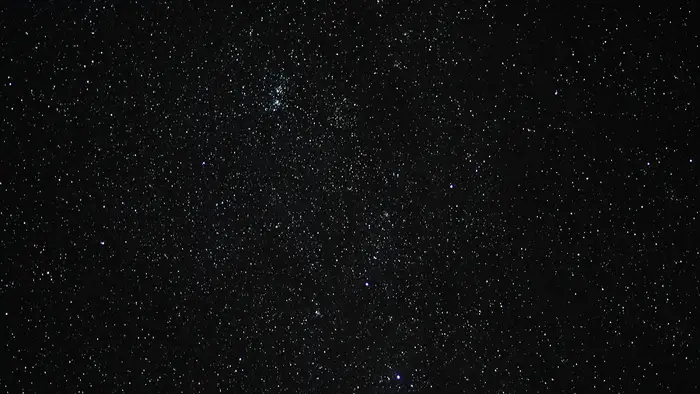
Stars scattered across the night sky. Future lensing surveys will measure the masses of clusters like El Gordo with unprecedented precision — and may decide the fate of the two-state model. Image: Unsplash.