Cat's Head Nebula 2026: Webb and Hubble Reveal a Newborn Star's Eye in Carina
Just in time for Halloween, the sky has offered up a cat. Not a constellation drawn by ancient storytellers, and not a trick of a telescope’s optics, but a real pillar of cold gas and dust, 7,500 light-years away, that happens to look uncannily like a cat sitting with its back to us and its head turned around to stare back at Earth. NASA released the new view on October 29, 2026, and within a day both of its great space telescopes — the veteran Hubble Space Telescope and the James Webb Space Telescope — had joined in, each showing the same feline shape in a different kind of light. The result is one of those rare astronomical images that works on two levels at once: it is instantly delightful, and it is genuinely useful, because the difference between what Hubble sees and what Webb sees tells astronomers how stars are born inside clouds that visible light cannot penetrate.
The feature is called the Cat’s Head Nebula, and it is a relatively small, dusty region tucked inside a far larger and more violent stellar nursery, the Carina Nebula. Carina is one of the Milky Way’s great star-forming regions, an immense cloud of gas and dust where, in NASA’s phrase, a maelstrom of star birth and death is taking place. It lies an estimated 7,500 light-years away in the southern constellation Carina, the Keel, part of the older and larger southern constellation Argo Navis, the ship of Jason and the Argonauts. Within that vast cloud, monster stars many dozens of times the mass of the Sun pour out scorching ultraviolet radiation and powerful stellar winds, carving cavities, compressing cold hydrogen, and sculpting the remaining gas into pillars, ridges, and filaments. The Cat’s Head is one of those sculpted remnants: a long, thin structure of dark, dense dust whose denser material has, at least for now, resisted being eroded away by its brilliant neighbours.
What makes the new release more than a seasonal curiosity is the way NASA’s Goddard Space Flight Center team lined the views up side by side. Seen that way, the same pillar becomes a lesson in how astronomers read the universe. Hubble, working in visible light, shows the structure as opaque, its starlight scattered by dust, its edges ringed by luminous gas. Webb, working in the infrared, looks through much of that dust and reveals texture, background stars and galaxies, and infant stars that visible light hides completely. The cat, in other words, changes its expression depending on the wavelength you use to look at it — and each expression reveals a different stage of the same story: a cloud being destroyed by massive stars, and new stars forming inside it even as it is destroyed.
A pillar with a glowing eye
In Hubble’s visible-light view, the Cat’s Head is dominated by darkness. The pillar itself is a column of cold dust so thick that starlight behind it is blocked or scattered, giving the structure its opaque, almost solid appearance. Around its edges, a luminous ring of gas glows, lit by the fierce radiation of nearby massive stars. Hubble’s image reveals light from oxygen, hydrogen, and sulfur, the familiar palette of glowing nebulae, while ionized gases lend a blue tint to the exterior. And within the dark pillar, one spot stands out: a glowing red point that serves as the cat’s eye.
That red spot, astronomers say, is likely an embedded infant star, still shrouded by the dust and gas from which it formed. It is the kind of object that visible-light telescopes can hint at but cannot fully resolve, because the very material that makes the star interesting — the dense cocoon in which it is still gathering mass — also hides it from view. The eye is therefore both the most charming detail of the image and the most scientifically suggestive: something is already shining inside the pillar, even though the pillar itself looks dark and cold.
NASA’s description of the shape is deliberately playful, and the space agency’s social media accounts leaned into the Halloween timing. The Webb account described the view as a “purr-fect” look at a long, thin structure of dark, dense dust, its eye a newborn star still wrapped in its birth material. The Hubble account warned followers to beware the space cat lurking about 7,500 light-years away, noting that this cosmic cat is in the process of forming new stars. The humour is earned, because the resemblance is not forced. The structure really does read as a cat: a head in profile, an ear, and an eye that seems to watch the viewer. Astronomers have a word for this tendency of the human brain to find familiar shapes in random patterns — pareidolia — and astronomy has always lived with it, from constellations named for animals and mythological creatures to nebulae nicknamed for the shapes they suggest. The Cat’s Head simply continues that tradition, with the difference that modern telescopes can now show us what the shape is actually made of.
What Webb sees that Hubble cannot
Webb’s contribution comes in two infrared instruments, and each tells a different part of the story. The Near-Infrared Camera, known as NIRCam, observes at wavelengths just beyond visible light. In its view, the filament becomes more transparent. The pillar no longer looks like a solid wall; instead, it gains complex texture, and a host of background stars and galaxies that were hidden behind the dust suddenly appear. The eye, which glows red in Hubble’s visible view, transforms in the near-infrared, appearing yellow as Webb peers deeper into the warm material surrounding the infant star. That colour change is not cosmetic. It reflects a real physical difference: near-infrared light passes through dust more easily than visible light, so Webb is seeing warmer, more deeply embedded material that Hubble cannot reach.
The Mid-Infrared Instrument, or MIRI, goes further still. MIRI captures emissions from warm dust and carbon-based molecules in and around the nebula, material excited by starlight filtering into the cloud. In the mid-infrared view released by NASA on October 29, 2026, intricate structures within the nebula are illuminated, and a bright yellow source just to the right of the primary pillar is probably another young star shining through the dusty, red environment. Delicate wisps of dust and gas to the left of the cat, exposed to radiation from nearby massive stars, also stand out in this view. Where Hubble shows a dark shape against glowing gas, MIRI shows a landscape of warm dust, glowing molecules, and young stars emerging from it.
Taken together, the three views — Hubble in visible light, Webb’s NIRCam in the near-infrared, and Webb’s MIRI in the mid-infrared — form a kind of depth chart. Visible light shows the surface: the shape of the pillar, the glowing rim, the scattered starlight. Near-infrared light shows what lies just beneath that surface: the filament’s internal texture and the stars behind it. Mid-infrared light shows the warm dust itself, the material out of which stars are forming and into which massive stars are pouring energy. No single view tells the whole story, and that is precisely the point of observing the same object across the electromagnetic spectrum. Infant stars that are heavily obscured in visible light stand out far more clearly in the infrared, giving astronomers a window into the earliest stages of star formation that would otherwise remain closed.
Inside Carina, a nursery under assault
To understand why the Cat’s Head looks the way it does, it helps to zoom out to its parent cloud. The Carina Nebula, also catalogued as NGC 3372, is one of the largest and brightest star-forming regions in the Milky Way, spanning hundreds of light-years and easily visible to the unaided eye under dark southern skies, despite lying 7,500 light-years away. NASA notes that it contains at least a dozen brilliant stars estimated to be at least 50 to 100 times the mass of the Sun. Those stars are the architects of the nebula’s landscape. Their outflowing winds and scorching ultraviolet radiation sculpt the surrounding gas, blowing cavities in the cloud and compressing the walls of cold molecular hydrogen that surround those cavities. That compression, in turn, triggers a second stage of star formation, as dense pockets of gas collapse under their own gravity and ignite as new stars.
The process began, in Carina’s case, about three million years ago, when the nebula’s first generation of newborn stars condensed and ignited in the middle of a huge cloud of cold molecular hydrogen. Our Sun and solar system may have been born inside just such a cosmic crucible some 4.6 billion years ago, which is one reason Carina is studied so intensively: it shows star formation as it commonly occurs along the dense spiral arms of a galaxy like our own, on a scale large enough and close enough for telescopes to resolve in detail. The Cat’s Head is a small chapter in that much larger story, a pillar left standing after the surrounding gas was eroded away, still dense enough to shelter the next generation of stars inside it.
The most famous resident of Carina is Eta Carinae, an unstable, behemoth double-star system that ranks among the largest and brightest star systems in the Milky Way. NASA describes the larger of the pair as about 90 solar masses, with a smaller companion of about 30 solar masses, and notes that the more massive star is destined to explode as a supernova. In the mid-1800s, Eta Carinae underwent a 20-year outburst known as the Great Eruption, during which it became the second brightest star in the sky, an event whose light echo astronomers have since studied with Hubble. Eta Carinae is not the star sculpting the Cat’s Head directly, but it embodies the forces at work across Carina: massive stars that live fast, shine brilliantly, expel enormous amounts of material, and ultimately die violently, reshaping everything around them in the process. The Cat’s Head, sculpted over time by the intense ultraviolet radiation and winds from massive stars in Carina, is what remains when those forces meet a pocket of gas dense enough to resist them — for a while.
That resistance is temporary. As stellar feedback continues to erode the surrounding gas and dust, denser material within the feline-shaped pillar resists erosion, at least for now, in NASA’s careful phrasing. “For now” is doing a lot of work in that sentence. Pillars like this one are transient structures on astronomical timescales. They are the shadows cast by dense clumps that shield the gas behind them from radiation, while the less dense gas around them is blown away. Eventually, the shielding clump itself is eroded, the pillar disperses, and the infant stars inside it emerge into the open cluster. The Cat’s Head is therefore a snapshot of a fleeting moment: a star-forming pillar caught in the act of being destroyed by the very process that created the stars inside it.
Why two telescopes are better than one
The Cat’s Head release is also a quiet demonstration of how modern astronomy works as a relay between generations of telescopes. Hubble, launched in 1990 and still operating more than three decades later, remains the benchmark for sharp visible-light imaging. Webb, launched in December 2021 and operating from the Sun-Earth Lagrange point L2, about 1.5 million kilometres from Earth, extends that vision into the infrared with a 6.5-metre primary mirror and instruments cooled to cryogenic temperatures. The two telescopes are operated as an international partnership: Webb is a joint project of NASA, the European Space Agency, and the Canadian Space Agency, while Hubble is a NASA and ESA collaboration. NASA’s release emphasises that international cooperation, noting that the partnership continues to deepen our understanding of stellar and galactic processes across the observable universe.
That cooperation matters practically as well as politically. No single telescope can cover the full range of wavelengths needed to understand a star-forming region, and no single observation can capture both the grand structure of a nebula and the fine detail of the stars forming within it. Hubble’s visible-light view gives astronomers the shape, the glowing gas, and the context. Webb’s infrared views give them the embedded stars, the warm dust, and the molecules. Future telescopes will add further layers: the Nancy Grace Roman Space Telescope, now in orbit and entering its science commissioning phase, will survey the sky in the infrared over fields far wider than Webb can cover, finding more objects like the Cat’s Head for Webb and other telescopes to study in detail. The Cat’s Head images are thus part of a longer chain, in which each generation of telescopes trains the next and extends what the previous generation could see.
For readers who follow Webb’s work, the Cat’s Head also fits a pattern. Webb has repeatedly returned to star-forming regions — from the Pillars of Creation in the Eagle Nebula to the turbulent N159 complex in the Large Magellanic Cloud, 161,000 light-years away — and each time, the infrared view has revealed stars and structures that visible-light images had only hinted at. The Lion Nebula, NGC 2392, photographed by Webb in a striking portrait earlier this year, showed a dying star shedding its outer layers in intricate detail. The Cat’s Head shows the opposite end of the stellar life cycle: a star being born, not dying, inside a cloud that is itself being sculpted by stars that have already been born. Together, those images trace the full circle of stellar life, from the cold clouds in which stars condense to the glowing shells they leave behind when they die.
That circle is worth pausing on, because it reframes what a Halloween image of a space cat actually is. The pillar is not a decoration. It is a place where the raw material of stars — hydrogen, dust, and a sprinkling of heavier elements forged in earlier generations of stars — is being gathered, compressed, and heated until nuclear fusion ignites. The eye is not a trick of the light. It is, in all likelihood, a real infant star, already shining, still surrounded by the material from which it formed, and destined, if it is massive enough, to one day sculpt its own surroundings in turn. The cat will not last: the pillar will disperse, the infant star will emerge, and the shape that delighted observers in October 2026 will fade into the wider glow of Carina. But the star will remain, and so will the record of how it looked when it was still hidden inside its birth cloud.
How to see it, and what comes next
For most readers, the Cat’s Head will remain a photograph rather than a sight through a backyard telescope. It lies in the southern constellation Carina, best seen from the Southern Hemisphere, and its pillar is a small feature inside a nebula that is itself a telescopic and photographic target rather than a naked-eye spectacle in detail. What is accessible to everyone is the comparison itself: NASA’s side-by-side visualization, generated by the Goddard team, puts Hubble’s and Webb’s views of the same feature next to each other, so that the same ridges, wisps, and glowing spots can be matched across wavelengths. That kind of comparison is increasingly how astronomy is communicated, and for good reason. It turns an abstract claim — that different wavelengths reveal different physics — into something a viewer can see directly, without needing to understand the underlying detector technology.
What comes next for the Cat’s Head itself is, in the strictest sense, more observation. Astronomers studying star formation will want to know the mass and age of the infant star that forms the eye, the density and temperature of the dust around it, and whether the pillar contains other, fainter protostars that even Webb’s current images have not resolved. Those questions require spectroscopy — spreading the light from the pillar into its component wavelengths to identify molecules, measure velocities, and estimate temperatures — as well as deeper imaging that can separate faint embedded sources from the background stars and galaxies that crowd Webb’s infrared field. None of that work is promised in NASA’s image release, which is, by design, a showcase rather than a research paper. But the history of Hubble and Webb image releases suggests that showcase images often become research targets, as astronomers request follow-up observations of features that the public first sees as beautiful pictures.
There is also a broader lesson in the timing. The Cat’s Head was released on October 29, 2026, and shared by both telescope teams on October 29 and 30, just ahead of Halloween. That timing is not accidental, and it is not cynical either. Astronomy has always used the calendar — eclipses, meteor showers, planetary alignments, and now Halloween — to invite people to look up. The difference now is that the invitation comes with data of real scientific value attached. The same image that makes a good Halloween post also shows, in three wavelengths, how a pillar of dust shelters a newborn star while massive neighbours try to tear it apart. If a viewer comes for the cat and stays for the physics, the release has done its job twice over.
The Cat’s Head will not be the last seasonal image from Webb and Hubble, and it will not be the most scientifically consequential image of 2026. It does not announce a new planet, a new particle, or a new law of physics. What it does, quietly and effectively, is show the scientific method in miniature: look at the same thing in different ways, compare what changes and what stays the same, and use the differences to infer what you cannot see directly. Hubble sees the pillar. Webb sees through it. Together, they see a star being born inside a cloud that is being destroyed by stars that were born before it. That is the whole story of star formation, told by a cat 7,500 light-years away, staring back at us from the dark.

Star-forming clouds glow against the darkness of deep space. Image: Unsplash.
The visible-light cat
Hubble’s view is the one that most resembles a photograph in the everyday sense, because it records the same kind of light our eyes can see, albeit with far greater sensitivity and resolution. In that view, the pillar’s opacity is the dominant impression. Dust grains, each far smaller than a grain of sand, scatter and absorb visible light so effectively that a cloud only a few light-years thick can hide everything behind it. That is why the Cat’s Head looks solid, and why its eye stands out so sharply: the infant star’s light, reddened and dimmed by the dust around it, is one of the few visible-light signals to escape the pillar at all. Around the pillar, the gas glows because it is being energised by ultraviolet light from massive stars, its atoms of hydrogen, oxygen, and sulfur emitting light at characteristic wavelengths that give nebulae their colours.
The luminous ring around the pillar’s edges is a signature of that energising process. Where radiation meets dense gas, it ionises the atoms, stripping electrons away, and when those electrons recombine, they emit light. The result is a glowing rim that traces the boundary between the dense pillar and the thinner gas around it, a boundary that is also a battleground: radiation and winds push inward, eroding the pillar, while the pillar’s density shields the gas behind it. Astronomers read that rim the way a geologist reads a cliff face, as a record of erosion in progress. The blue tint of the exterior, produced by ionized gases, adds another layer, marking regions where the gas is hotter and more thoroughly ionised than the cooler, redder material deeper inside the pillar.
It is worth remembering how remarkable it is that Hubble can still produce such images at all. The telescope has been operating since 1990, has survived gyroscope failures, instrument replacements, and multiple servicing missions, and continues to deliver visible-light and ultraviolet observations that complement Webb’s infrared work. The Cat’s Head release is a reminder that Hubble is not a retired predecessor to Webb but a working partner, whose wavelength coverage Webb does not duplicate. Without Hubble’s visible view, the infrared views would lack their most intuitive reference point: the shape that the human eye recognises as a cat, and against which the infrared transformations can be measured.
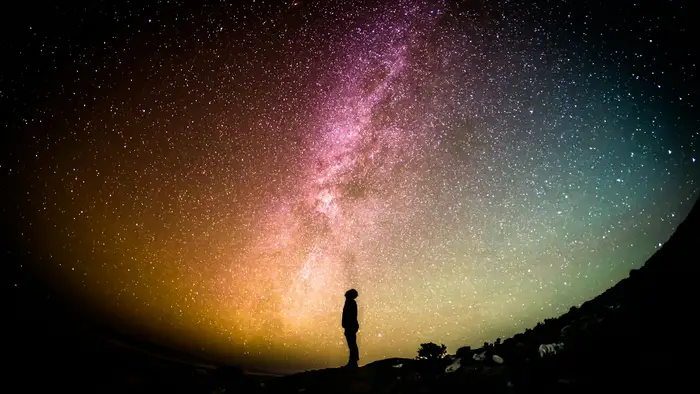
A dark pillar of dust stands against glowing gas in a stellar nursery. Image: Unsplash.
Through the infrared veil
Webb’s near-infrared view changes the image in ways that are easy to describe but profound in implication. The pillar becomes more transparent, not because the dust has disappeared, but because near-infrared wavelengths are longer than visible wavelengths and are therefore scattered less by dust grains. A cloud that is opaque in visible light becomes translucent in the near-infrared, like fog thinning as the Sun rises. Background stars and galaxies, previously hidden, appear by the dozens, turning a dark silhouette into a textured, three-dimensional scene. The eye’s change from red to yellow reflects the same physics: Webb is detecting light from warmer material closer to the infant star, material that visible light cannot escape from without being absorbed and reddened.
MIRI’s mid-infrared view goes further, into wavelengths where the dust itself glows. Warm dust grains, heated by starlight, emit thermal radiation in the mid-infrared, so MIRI does not merely look through the dust — it images the dust directly. That is why its view is dominated by warm, glowing structures and by carbon-based molecules excited by infiltrating starlight, the chemical fingerprints of a cloud in which complex molecules are already forming. The bright yellow source just to the right of the primary pillar, probably another young star, is a case in point: in visible light it would be lost in the glare and dust, but in the mid-infrared it stands out as a warm, compact source against the cooler, redder background. The delicate wisps to the left of the cat, exposed to radiation, are similarly revealed as structures of warm dust and gas, not mere shadows.
Together, these views allow astronomers to build a three-dimensional model of the pillar that no single wavelength could provide. They can estimate where the densest gas lies, where the youngest stars are embedded, and how far radiation from massive stars has penetrated into the cloud. They can distinguish between stars that lie behind the pillar and stars that lie inside it, a distinction that matters enormously for understanding whether star formation in the pillar is ongoing, triggered by external compression, or already winding down as the pillar disperses. That is the scientific payoff of a Halloween image: not just a pretty picture, but a dataset that can be mined for years.
The same multi-wavelength approach has transformed other fields of astronomy in recent years. Studies of Webb’s portrait of the Lion Nebula, NGC 2392 showed how infrared imaging reveals the intricate shells shed by a dying star, while Webb’s view of the N159 star-forming region in the Large Magellanic Cloud revealed turbulent gas 161,000 light-years away in a galaxy with lower metallicity than our own. The broader survey of Webb telescope discoveries in 2026 shows how routinely the observatory now pairs visible and infrared views to trace both the birth and death of stars. The Cat’s Head belongs in that lineage: a small, charming feature that, examined across wavelengths, becomes a case study in how stars are born.

Infrared light reveals warm dust and young stars hidden inside a nebula. Image: Unsplash.
A nursery, a monster, and a fleeting shape
Carina’s scale is difficult to grasp from a single pillar. The nebula as a whole is one of the Milky Way’s largest star-forming regions, and its history stretches back millions of years. The first generation of stars ignited about three million years ago, and their winds and radiation have been reshaping the cloud ever since, triggering further rounds of star formation in compressed walls of gas. That feedback loop — massive stars destroy their birth cloud, but in destroying it they compress new pockets of gas that form new stars — is one of the central processes regulating star formation across galaxies. Carina is valuable precisely because it shows that loop operating at full intensity, with stars up to 100 times the Sun’s mass driving it.
Eta Carinae sits at the extreme end of that process. A binary system whose primary star is about 90 times the Sun’s mass, with a companion of about 30 solar masses, it is unstable, eruptive, and destined for a supernova explosion. Its Great Eruption in the mid-1800s, a 20-year event that made it the second brightest star in the sky, expelled vast amounts of material and left behind the billowing lobes of gas and dust that astronomers still study today. Eta Carinae is a warning about what massive stars do: they do not fade quietly. They blast their surroundings, enrich the interstellar medium with heavy elements, and trigger or suppress star formation in neighbouring clouds. The Cat’s Head, sculpted by less extreme but still powerful massive stars, is a gentler version of the same story, a pillar that has survived long enough to form a star of its own before it is dispersed.
The fleeting nature of pillars is part of their scientific interest. Unlike stars, which shine for millions or billions of years, pillars are structures that exist for a relatively short interval between the formation of a dense clump and its eventual erosion. Catching one at the moment when an infant star is visible inside it — the eye of the cat — is therefore a fortunate snapshot, a moment in a process that will not last. Future observations, decades or centuries from now, would show a different shape, or no pillar at all, as the infant star emerges and the remaining gas is blown away. The image released in October 2026 freezes that moment, and the side-by-side comparison freezes it in three wavelengths at once, giving astronomers a baseline against which future change, if any is detectable on human timescales, can be measured.
Massive stars light up the gas and dust of a vast stellar nursery. Image: Unsplash.
Why the cat matters beyond Halloween
It would be easy to dismiss the Cat’s Head as a seasonal novelty, a pretty picture timed for social media. That would miss why NASA and its partners release such images, and why astronomers take them seriously. Public images are not separate from science; they are often the first step toward it. A striking image draws attention to a region, prompts questions about what is actually happening there, and justifies the telescope time needed to answer those questions with spectroscopy and deeper imaging. The Cat’s Head has already done the first part: it has put a small pillar in Carina on the map for a public that might otherwise never have heard of it. The second part — detailed study of the infant star, the pillar’s density, and the feedback from neighbouring massive stars — is the work that follows, and it is work that the multi-wavelength dataset already makes possible.
There is also a human reason the image resonates. Pareidolia, the tendency to see faces and familiar shapes in random patterns, is often treated as a quirk or a flaw, a trick the brain plays. In astronomy, it has historically been a tool: constellations are pareidolia systematised, a way for humans to navigate the sky by grouping stars into bears, hunters, ships, and cats. The Cat’s Head continues that tradition, but with a difference. Earlier generations saw shapes and invented stories about them. Modern astronomers see shapes and then test them, measuring the light, the temperature, and the chemistry behind the shape until the story becomes a physical explanation. The cat is still a cat, in the sense that the shape is real and recognisable. But it is also a pillar, a nursery, and a snapshot of stellar feedback, all at once. Holding those descriptions together — the poetic and the physical — is what makes astronomy, at its best, both accessible and rigorous.
As Halloween passes and the Cat’s Head fades from social media feeds, the pillar itself will continue its slow dissolution, 7,500 light-years away, indifferent to the holiday that brought it attention. The infant star inside it will continue to gather mass, or to clear its surroundings, on a timescale far longer than any human calendar. And the images will remain, archived by NASA, ESA, and CSA, available for astronomers to revisit whenever they need a clear example of how visible and infrared views complement each other. That is the lasting value of the release: not a cat for a day, but a case study for years, showing how two telescopes, looking at the same cloud in different light, can reveal a star being born inside a shape that looks, improbably and delightfully, like a cat staring back at Earth.

A newborn star shines through the gas and dust of its birth cloud. Image: Unsplash.